Signs of an Alien Atmosphere? James Webb May Have Just Found the First Breathable World Beyond Earth
Astronomers using NASA’s James Webb Space Telescope (JWST) have made a discovery that could rewrite the story of life in the cosmos. Recent observations reveal tantalizing evidence of an atmosphere on a rocky planet orbiting a distant star — just 41 light-years away.
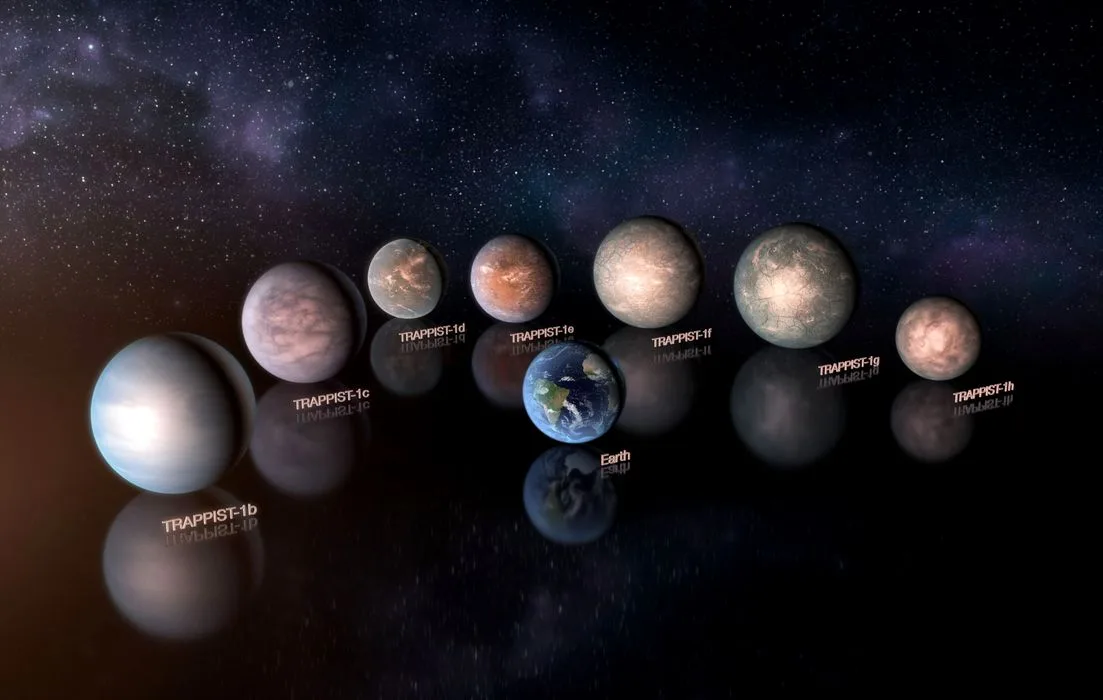
The world, known as TRAPPIST-1e, orbits within the so-called “habitable zone” — the sweet spot around a star where temperatures are just right for liquid water to exist. Water is the foundation of life as we know it, and finding it beyond Earth has been one of astronomy’s ultimate goals.
If future data confirm these initial results, this would mark a historic milestone: the first-ever detection of an atmosphere around a rocky exoplanet in a star’s habitable zone.
A Breakthrough in the “Goldilocks Zone”
Being in the habitable zone isn’t enough for life to thrive. A planet also needs an atmosphere — one capable of trapping heat through the greenhouse effect to keep surface water from evaporating into space.
To investigate whether TRAPPIST-1e possesses such a protective layer, an international team directed humanity’s most powerful space telescope toward the system. Their goal: to find signs of air on one of the seven rocky planets orbiting the cool red dwarf TRAPPIST-1.
The results were ambiguous — pointing to two possible scenarios: either the planet has a dense, secondary atmosphere composed of heavy molecules like nitrogen and methane, or it is a barren, airless rock.
A System Unlike Any Other
Since its discovery in 2016, the TRAPPIST-1 system has fascinated scientists. Three of its planets — TRAPPIST-1d, 1e, and 1f — sit in the star’s habitable zone. Because red dwarfs are smaller and cooler than our Sun, their habitable zones lie closer in, shortening planetary orbits and allowing astronomers to collect far more data in less time.
This advantage makes red dwarf systems ideal for studying exoplanet atmospheres. During planetary transits — when a planet passes in front of its star — starlight filters through any surrounding gases. By measuring how this light is absorbed, researchers can identify the chemical makeup of an atmosphere, if one exists.
JWST has been monitoring TRAPPIST-1e since 2022. The telescope conducted four major observations between June and October 2023, but separating the planet’s faint signal from the star’s noisy activity — including starspots and magnetic storms — required over a year of analysis.
A New Chapter in the Search for Life
Now, scientists are on the verge of a breakthrough. If TRAPPIST-1e’s atmosphere is confirmed, it would not only be a first in exoplanet science — it could also hint that Earth-like worlds capable of sustaining life may be far more common than we thought.
To be truly habitable, the planet would need a thick atmosphere and a stable greenhouse effect to maintain liquid water. JWST is currently conducting 15 additional transit observations to refine the data. By comparing the signatures from TRAPPIST-1e with those of its airless neighbor, TRAPPIST-1b, astronomers hope to deliver a definitive answer.
If the signals match expectations, we may soon be looking at the first alien world with a breathable sky — a place where the conditions for life might already exist.