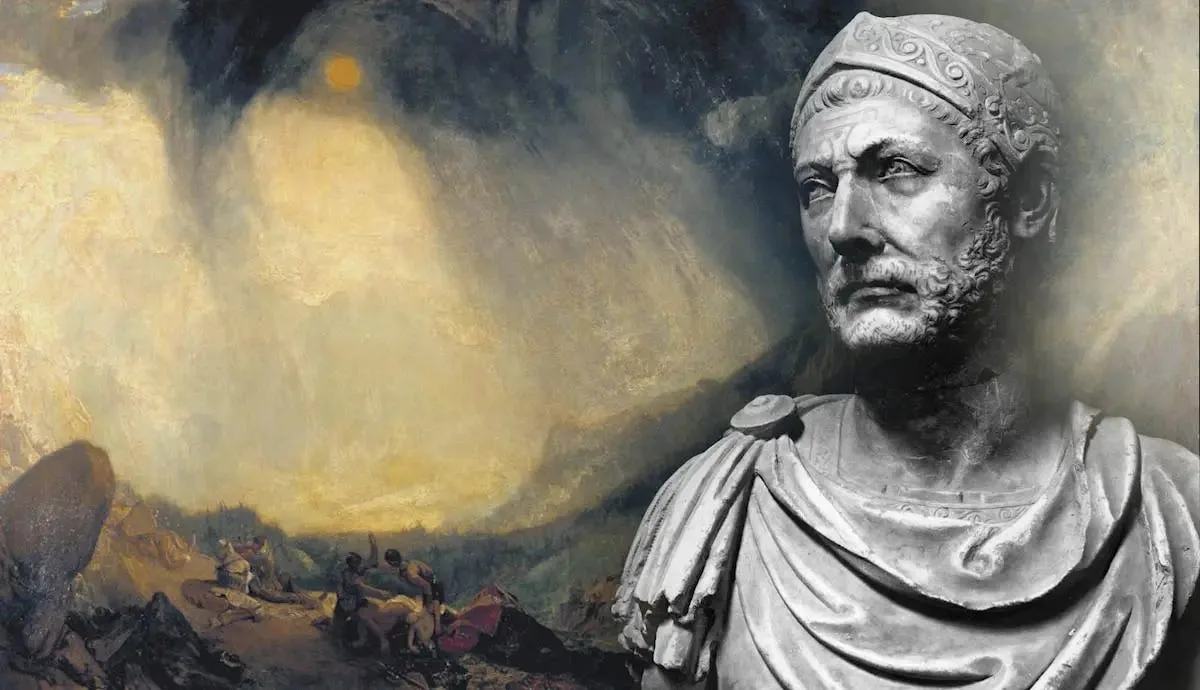
Considered one of the greatest military masterminds of Western antiquity—standing alongside legends such as Alexander the Great, Cyrus the Great, Julius Caesar, Scipio Africanus, and Pyrrhus—Hannibal Barca carved his name into history as the man who brought Rome to its knees. He is best remembered for leading the Carthaginian army, with its fearsome war elephants, across southern Europe and the treacherous Alps in a bold assault during the Second Punic War.
Hannibal’s brilliance and fearless leadership inspired deep loyalty among his men. At the height of his power, his forces numbered 90,000 infantry, 12,000 cavalry, and 37 elephants—a living engine of war unlike anything Rome had ever faced. To the Romans, he was both their greatest enemy and their most respected adversary, a commander who combined daring ambition with unrivaled tactical genius.
A Destiny Shaped by Vengeance
Born in 247 BC in Carthage (modern-day Tunisia), Hannibal was the son of the famed general Hamilcar Barca, who had fought Rome during the First Punic War. As a boy, Hannibal witnessed the devastation Rome inflicted on his homeland. At just six years old, his father led him to a sacred altar and made him swear a chilling oath: to be Rome’s enemy for life. That vow became the driving force of his destiny.
After Hamilcar’s death, command passed to Hannibal’s brother-in-law Hasdrubal. Hannibal honed his military skills under him until Hasdrubal’s assassination in 221 BC. At only 26, Hannibal was appointed supreme commander. Bold and charismatic, he quickly consolidated Carthage’s power in Spain, marrying a local princess, forging tribal alliances, and building his reputation as a leader destined for greatness.
When Rome allied with the city of Saguntum in 219 BC—deep in Carthage’s sphere of influence—Hannibal saw it as provocation. He besieged Saguntum for eight months until the city fell, an act that ignited the Second Punic War. Rome declared war. Hannibal answered with fire.
The Legendary Crossing of the Alps
Determined not just to fight Rome but to strike at its heart, Hannibal conceived one of the boldest campaigns in history: to march directly into Italy by crossing the Alps.
In 218 BC, with 90,000 soldiers and 37 elephants, he began his perilous trek. The journey was brutal—icy storms, avalanches, and attacks from hostile tribes decimated his ranks. Yet Hannibal pressed on. By the 15th day, though reduced to 25,000 infantry, 6,000 cavalry, and a handful of elephants, he had accomplished the impossible: the Carthaginian army stood at Rome’s doorstep.
What followed were some of the most spectacular victories Rome had ever suffered. Hannibal crushed Roman forces at Ticinus, Trebia, Lake Trasimene, and most famously, Cannae (216 BC)—where he encircled and annihilated a vastly superior Roman army in a maneuver still studied by military academies worldwide.
Exile, Defiance, and Death
Though undefeated on Italian soil for over a decade, Hannibal could not capture Rome itself. Eventually, Carthage’s resources dwindled, and he was recalled to defend his homeland. Defeated at the Battle of Zama by Scipio Africanus in 202 BC, Hannibal’s legendary campaign came to an end.
Back in Carthage, he entered politics, attempting financial reforms that angered the elite. Under Roman pressure, he was forced into exile. For years, he drifted between royal courts in Asia Minor, still advising on warfare, still hunted by Rome. Finally cornered by Roman agents in Bithynia around 183–181 BC, Hannibal chose death over capture, taking poison—a final act of defiance against the empire he had spent his life fighting.
Legacy of a Genius
Hannibal remains one of history’s greatest generals—a master of strategy, audacity, and psychological warfare. He proved that courage, ingenuity, and relentless willpower could challenge even the mightiest empire. To this day, his campaigns are studied as lessons in leadership, perseverance, and the art of turning the impossible into reality.
Hannibal Barca: the man who made Rome tremble.