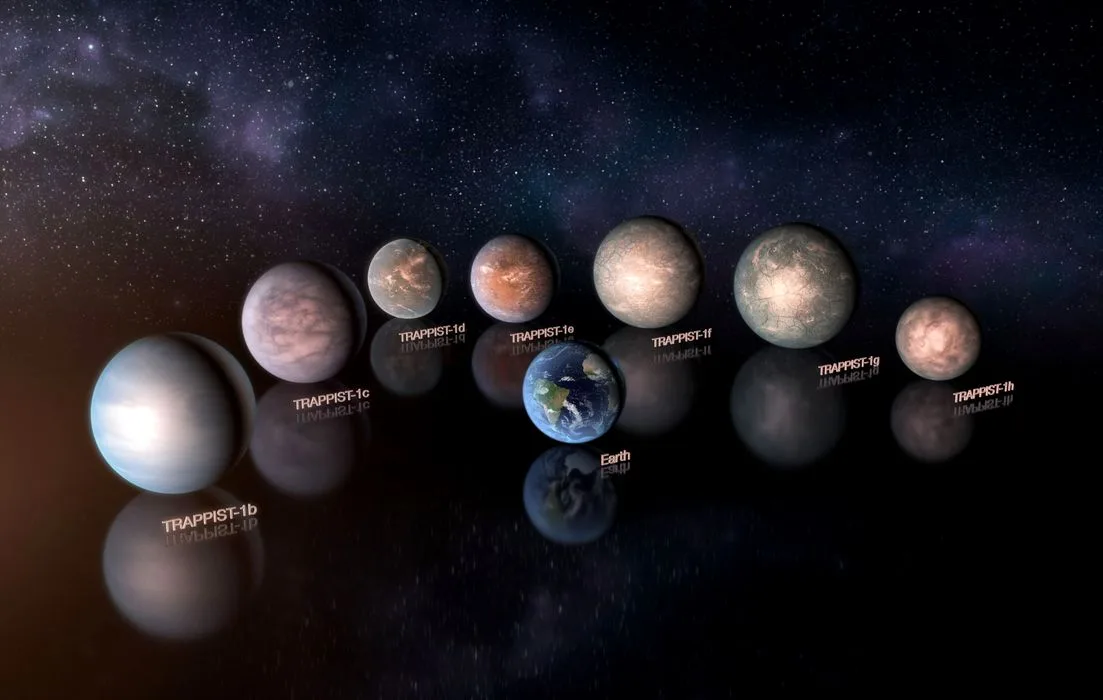
Just 40 light-years away, astronomers may have found the most Earth-like planet ever detected. The exoplanet TRAPPIST-1e, orbiting a cool red dwarf star, appears to be wrapped in an atmosphere that could potentially sustain life — a discovery that brings us one step closer to finding another habitable world.
New data from the James Webb Space Telescope (JWST) suggest that TRAPPIST-1e might have a gaseous envelope strikingly similar to Earth’s. That’s a crucial ingredient for liquid water to remain stable on the surface — and for life as we know it to exist.
The signal, while still ambiguous, is the strongest hint yet that we may not be alone in the universe. “TRAPPIST-1e remains one of the most intriguing planets in the habitable zone,” says MIT astronomer Sara Seager, co-author of one of the two new studies. “These results bring us closer to understanding its true nature. The fact that we can rule out Venus- or Mars-like scenarios lets us focus on other, far more exciting possibilities.”
The hunt for another Earth
Since its discovery in 2016, the TRAPPIST-1 system has fascinated scientists and the public alike. It’s a tiny red dwarf star with seven rocky planets, several of them in the so-called habitable zone — the “Goldilocks” region where temperatures allow water to exist as a liquid.
But there’s a catch: red dwarfs are volatile stars. Their frequent flares and bursts of radiation could strip away a planet’s atmosphere, leaving it barren and lifeless. Indeed, TRAPPIST-1d, another planet in the habitable zone, has shown no evidence of an atmosphere. TRAPPIST-1e, however, seems to be a luckier candidate.
A team led by Néstor Espinoza (Space Telescope Science Institute) and Natalie Allen (Johns Hopkins University) used JWST to observe the faint starlight filtering through TRAPPIST-1e’s atmosphere during its transits. Another group, led by Ana Glidden at MIT, analyzed the data and came to an intriguing conclusion: while not definitive, the results suggest the presence of a secondary atmosphere rich in nitrogen — much like Earth’s.
The evidence rules out a Venus-style atmosphere dominated by carbon dioxide and also excludes a hydrogen- or methane-heavy sky. Instead, the data fit best with an atmosphere composed mostly of nitrogen, laced with traces of carbon dioxide and methane.
The closest match to Earth yet?
“If these observations hold up, TRAPPIST-1e could be the closest thing we’ve ever found to Earth,” says astrophysicist Ryan MacDonald of the University of St Andrews. “Still, we can’t rule out the possibility that it has no atmosphere at all.”
The suspense won’t last forever: the James Webb telescope already has new observations planned that could soon confirm the truth.
“We’re just at the beginning of what Webb can do,” says Glidden. “It’s extraordinary that we can now analyze starlight from planets the size of Earth, 40 light-years away, and begin to ask whether they might host life. We’re living in a new era of exploration.”
The findings were published in The Astrophysical Journal Letters in two independent studies.
Sources: JWST-TST DREAMS: NIRSpec/PRISM Transmission Spectroscopy of the Habitable Zone Planet TRAPPIST-1 e