Early cancer detection has long been one of the biggest challenges in modern medicine. Now, scientists at Shenzhen University have developed a powerful light-based sensor capable of detecting extremely small amounts of cancer biomarkers in blood—even before a tumor becomes visible on medical scans.
The breakthrough technology, recently reported in Optica, could pave the way for routine blood tests that identify the earliest warning signs of cancer and other serious diseases.
Why Early Cancer Detection Is So Difficult
Cancer biomarkers—such as proteins, fragments of DNA, and microRNAs—can reveal whether cancer is present, how it is progressing, and even a person’s risk of developing the disease.
The problem?
In the earliest stages of cancer, these biomarkers exist in extremely low concentrations, often at levels too faint for conventional diagnostic tools to detect. Current testing methods typically rely on chemical amplification to boost molecular signals, adding time, complexity, and cost to the process.
Detecting cancer before it appears on a CT scan has remained a major scientific goal—until now.
How the CRISPR-Powered Light Sensor Works
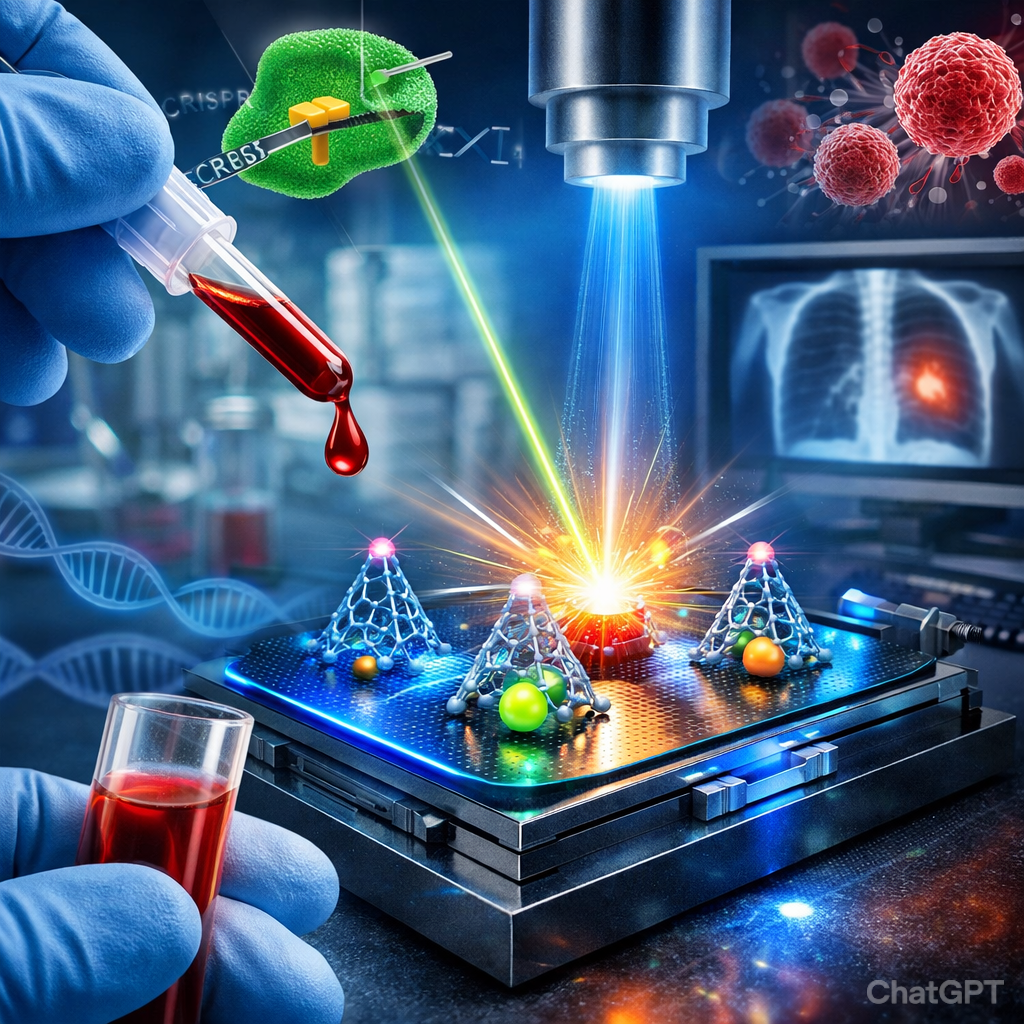
Led by researcher Han Zhang, the team created a sensor that combines:
- DNA nanostructures
- Quantum dots
- CRISPR gene-editing technology
- A light-based technique called second harmonic generation (SHG)
This innovative approach allows doctors to detect even the faintest molecular signals in a drop of blood.
The Role of Second Harmonic Generation (SHG)
The system relies on SHG, a nonlinear optical phenomenon in which incoming light is converted into light with half its wavelength. Because SHG produces very little background noise, it enables ultra-sensitive measurements.
In this design, SHG occurs on the surface of a two-dimensional semiconductor called Molybdenum disulfide (MoS₂), which enhances signal precision.
DNA Nanotechnology Meets Quantum Physics
To ensure nanoscale precision, researchers built DNA tetrahedrons—tiny pyramid-shaped structures made entirely from DNA. These act as programmable scaffolds, holding quantum dots at exact distances from the MoS₂ surface.
The quantum dots amplify the local optical field, strengthening the SHG signal and making even trace biomarkers detectable.
“Instead of viewing DNA only as biological material, we use it as programmable building blocks,” explained Zhang. “This allows us to assemble sensor components with nanometer-level precision.”
CRISPR Adds Unmatched Specificity
The system incorporates CRISPR-Cas gene-editing technology for highly specific biomarker recognition.
When the Cas12a protein identifies its target biomarker, it cuts the DNA strands anchoring the quantum dots. This action produces a measurable drop in the SHG signal—clearly indicating the presence of the target molecule.
Because the system is amplification-free, it avoids many of the drawbacks of traditional molecular testing while maintaining exceptional sensitivity.
Detecting Lung Cancer at Sub-Attomolar Levels
To test real-world performance, researchers focused on miR-21, a microRNA strongly associated with lung cancer.
After confirming detection in controlled lab conditions, the team analyzed human serum samples from lung cancer patients. The results were remarkable:
- The sensor detected miR-21 at sub-attomolar levels
- It identified only the target biomarker
- It ignored similar RNA strands
- It produced clear, measurable signals even when only a few molecules were present
According to Zhang, this technology could enable:
- Early lung cancer screening before tumors appear on CT scans
- Frequent monitoring of biomarker levels
- Faster evaluation of treatment effectiveness
- More personalized cancer therapy
Instead of waiting months for imaging results, doctors could monitor biomarker changes weekly—or even daily.
Beyond Cancer: A Platform for Multiple Diseases
One of the most exciting aspects of the technology is its programmability.
Because the platform can be adapted to recognize different molecular targets, it may eventually detect:
- Viruses
- Bacteria
- Environmental toxins
- Neurodegenerative disease markers such as those linked to Alzheimer’s
This flexibility opens the door to a new generation of highly sensitive, low-cost diagnostic tools.
Toward Portable Bedside Testing
The current system is laboratory-based, but the research team’s next goal is miniaturization.
They aim to develop a portable, bedside device that could be used:
- In outpatient clinics
- In emergency settings
- In remote or low-resource areas
- For routine annual health screenings
If successful, this innovation could simplify disease detection, improve survival rates, and significantly reduce healthcare costs worldwide.
The Future of Cancer Screening
Early detection dramatically improves cancer survival rates. A simple blood test capable of identifying cancer before imaging scans could transform preventive medicine.
By combining nanotechnology, quantum physics, and CRISPR gene editing, scientists may have taken a major step toward making early cancer diagnosis faster, simpler, and more accessible.
As research progresses and portable systems become available, routine blood draws could soon reveal what today’s scans cannot—offering patients a critical head start in the fight against cancer.