Two-dimensional (2D) materials are rewriting the rules of green chemistry. Among them, MXenes—ultra-thin compounds based on carbides and nitrides—emerge as revolutionary catalysts. These incredible atomic materials have the potential to unlock green ammonia production, directly converting elements from the air into essential fertilizers and clean fuels.
The Atomic Alchemy of MXenes: From the Lab to Sustainable Agriculture
The research, conducted by chemical engineering professors at Texas A&M University, Dr. Abdoulaye Djire and Dr. Perla Balbuena, along with Ph.D. candidate Ray Yoo, and detailed in the Journal of the American Chemical Society, is challenging the foundations of industrial catalysis.
Ammonia is the backbone of modern agriculture, but its traditional production (the Haber-Bosch process) is energy-intensive and responsible for about 1-2% of global carbon emissions. Scientists are seeking to replace this process with electrocatalytic ammonia synthesis—a cleaner, more sustainable method that uses electricity (ideally from renewable sources) to capture nitrogen (from the air) and hydrogen (from water).
This is where MXenes come in. These low-dimensional compounds not only promise to make electrocatalysis efficient, but also offer unprecedented control over their chemical reactivity.
Rewriting the Rules of Catalysis: Beyond the Simple Metal
For decades, the dogma in catalyst design dictated that a material’s effectiveness depended primarily on the transition metal it contained. Dr. Djire’s team is expanding this understanding, focusing on the critical role of non-metallic atoms within the crystalline lattice structure.
“Our goal is to expand our understanding of how materials function as catalysts under electrocatalytic conditions,” said Dr. Djire. “Ultimately, this knowledge will help us identify the key components needed to produce chemicals and fuels from earth-abundant resources.”
Atomic Tuning: Sub-Angstrom Optimization
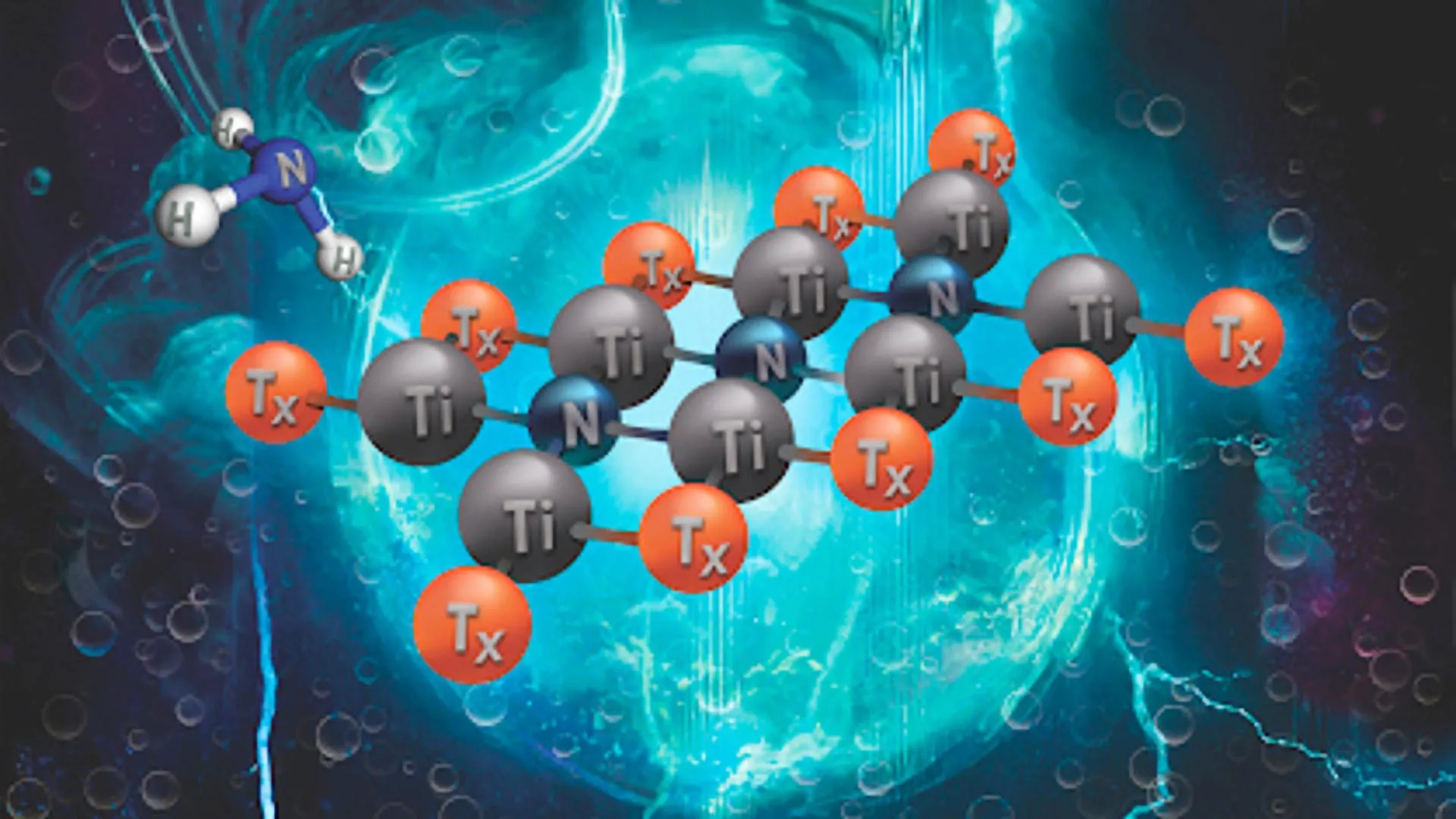
The true magic of MXenes lies in their ability to be “tuned” at the atomic level. Their structure can be modified by changing the way nitrogen atoms interact within the crystalline lattice—a phenomenon known as lattice nitrogen reactivity.
This modification directly influences the vibrational properties of the molecules, which are crucial in determining a material’s effectiveness in promoting chemical reactions. The ability to fine-tune these properties makes MXenes ideal candidates for a wide range of renewable energy applications, overcoming the limitations of costly traditional electrocatalytic materials.
Ray Yoo, Ph.D. candidate and co-author, highlighted the advantage: “Nitride-based MXenes represent extremely promising alternatives to their widely studied carbide counterparts, due to their improved performance in electrocatalysis.”
From Computational Insight to Atomistic Control
To grasp the complexity of these processes, Ph.D. student Hao-En Lai from Dr. Balbuena’s group conducted detailed computational studies. These simulations mapped the interactions between solvents (crucial for ammonia synthesis) and the MXene surfaces, allowing researchers to quantify the essential molecular dynamics.
In parallel, the researchers utilized Raman spectroscopy, a highly precise, non-destructive method. The Raman analysis of titanium nitride revealed detailed information about the lattice nitrogen reactivity—a key finding.
“I feel that one of the most important parts of this research is the ability of Raman spectroscopy to reveal the lattice nitrogen reactivity,” added Yoo. “This reshapes the understanding of the electrocatalytic system involving MXenes.”
Continuing to explore nitride MXenes and their interactions with polar solvents through Raman spectroscopy is a path that promises major advancements in the green chemistry of the future.
The Future is Atomic Control
The ultimate goal of this pioneering research is absolute control at the atomic level:
“We demonstrate that electrochemical ammonia synthesis can be achieved through the protonation and replenishment of lattice nitrogen,” concluded Dr. Djire. “The ultimate goal of this project is to gain an atomistic-level understanding of the role played by the atoms that constitute a material’s structure.”
This crucial research, which promises a future of sustainable fertility and decarbonization of transportation, received support from the U.S. Army DEVCOM ARL Army Research Office Energy Sciences Competency.
Credit: Dr. Abdoulaye Djire/Texas A&M University