The Hidden Saboteurs: How Tumors Corrupt the Body’s First Line of Defense
Understanding the intricate mechanics of how tumors expand and metastasize remains the “holy grail” of oncology. In a significant leap forward, researchers at the University of Geneva (UNIGE), in collaboration with the Ludwig Institute for Cancer Research, have unmasked a surprising culprit in cancer progression.
Their study, recently published in the prestigious journal Cancer Cell, reveals that neutrophils—the most abundant white blood cells and the body’s primary first responders—can be “reprogrammed” by the tumor environment. Instead of destroying the threat, these cells are coerced into becoming active accomplices that drive the disease forward.
Decoding the Tumor Microenvironment
Cancer does not exist in a vacuum. It thrives within a complex, highly interactive “ecosystem” composed of various cell types that constantly communicate. Dissecting which of these interactions are benign and which are lethal is one of the greatest hurdles in modern medicine.
“One of the difficulties lies in identifying, in an environment we are only now beginning to understand, the elements that truly influence the tumor’s ability to grow,” explains Mikaël Pittet, Professor at the UNIGE Faculty of Medicine and a leading member of the Ludwig Institute’s Lausanne Branch.
This new discovery builds upon a 2023 breakthrough by the same team, which linked specific macrophage genes to disease progression. “Our new study highlights a second vital variable,” says Pittet. “This time, the focus shifts to a different population of immune cells: the neutrophils.”
From Defenders to Promoters: The CCL3 Discovery
Under normal circumstances, neutrophils are the “infantry” of the immune system, rushing to sites of infection or injury. However, in the context of a malignancy, their presence is often an omen of a poor prognosis.
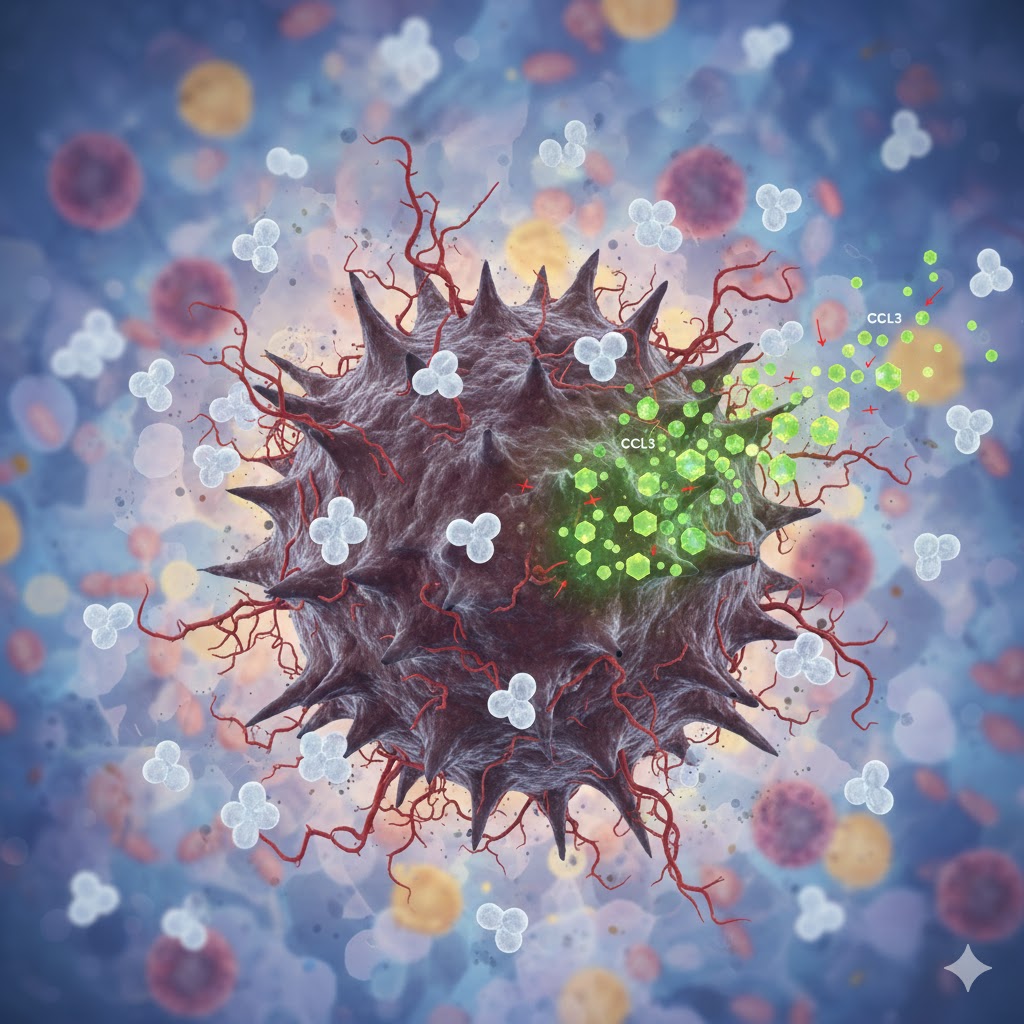
The researchers discovered that tumors actively recruit these cells and force a radical shift in their behavior. “We found that neutrophils recruited by the tumor undergo a reprogramming of their activity,” explains Pittet. “They begin producing a specific molecule locally—the chemokine CCL3—which directly facilitates tumor growth.”
Essentially, the tumor “hacks” the immune response, turning a protective mechanism into a fuel source for its own expansion.
Overcoming the “Invisible” Cell Challenge
Studying neutrophils has historically been a technical nightmare for scientists. They are notoriously fragile and resistant to genetic manipulation, often making them “invisible” in standard genomic datasets.
“Neutrophils are particularly difficult to study and to manipulate genetically,” notes Evangelia Bolli, co-lead author and former postdoctoral researcher at UNIGE, now at the Broad Institute of MIT and Harvard. To bypass these barriers, the team developed a sophisticated “surgical” approach to genetics.
“We combined different strategies to control the expression of the CCL3 gene specifically within neutrophils, without affecting its function in other parts of the body,” Bolli explains. The results were definitive: when CCL3 was deactivated, the neutrophils’ ability to support the tumor vanished. While the cells still reached the tumor site, they no longer possessed the “pro-tumor” programming necessary to help the cancer grow.
A Universal Pattern Across Multiple Cancers
To ensure these findings weren’t an isolated incident, the team utilized advanced bioinformatics to re-examine data from dozens of independent studies.
“We had to innovate to detect neutrophils more accurately,” says Pratyaksha Wirapati, co-first author and bioinformatics specialist. “Because of their low genetic activity, they often slip through the cracks of standard analysis tools.”
By applying a new, more sensitive detection method, the team proved that this CCL3 production is a common trajectory across many different types of cancer. This suggests that CCL3 is not just a random byproduct, but a universal marker of aggressive disease.
The Future: Toward Personalized “Identity Cards” for Tumors
The identification of CCL3 as a master regulator of tumor growth offers a new lens through which doctors can view cancer. It provides a measurable variable that could help predict how a patient’s disease will evolve.
“We are essentially deciphering the ‘identity card’ of tumors,” Pittet concludes. “Our work suggests that there is a limited number of these key variables. Once we identify them all, we can move toward a new era of personalized care—tailoring treatments to the specific cellular landscape of every individual patient.”