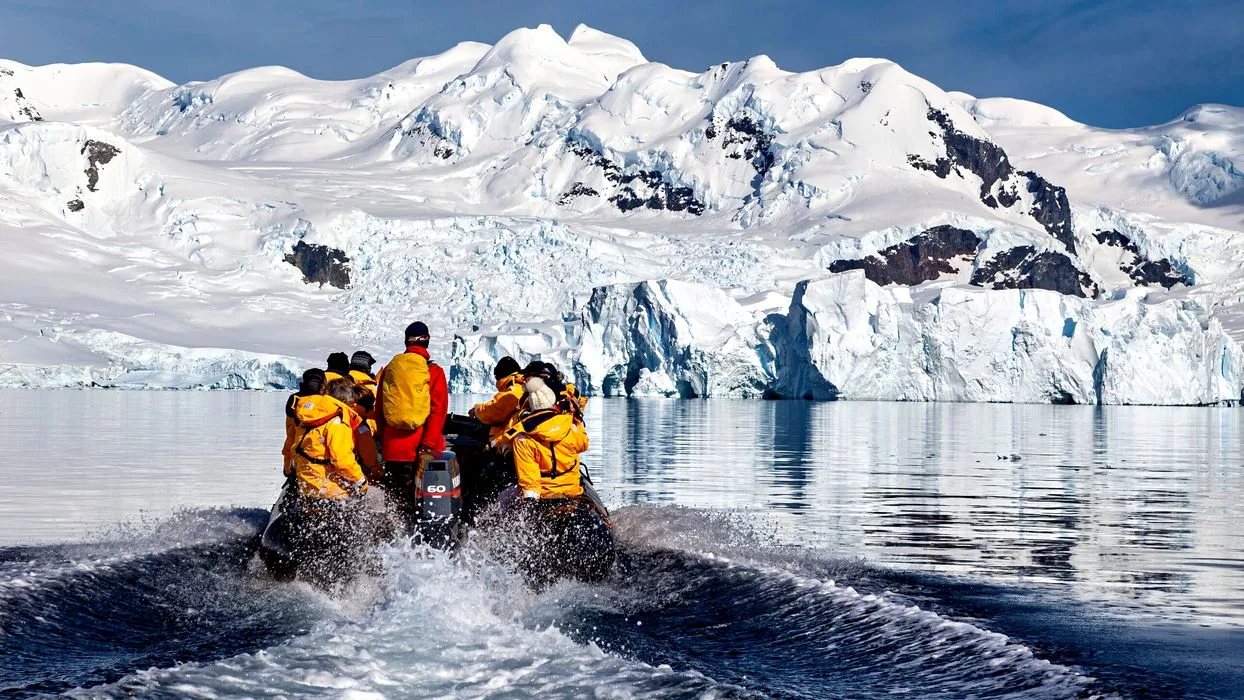
The most hostile territory on the planet doesn’t give you time to “get used to” the cold.
It hits you instantly—sharp, violent, breathtaking.
Before you can even process the shock, a vast white continent stretches before your eyes: Antarctica, the icy heart of our world, the absolute epicenter of Earth’s most extreme cold.
Nothing here is gentle. Nothing is forgiving.
This is what the planet looks like when it stops trying to be hospitable—a world sculpted by wind, ice, and silence. A place where nature pushes every physical limit to the edge of what life can endure.
Why Antarctica Is the Coldest Place on Earth
Antarctica’s extreme conditions are not random. They are the product of a perfect—and brutal—combination of geographic, atmospheric, and climatic factors unlike anywhere else on the planet.
The main drivers of the cold are:
- Polar night: during the long winter, the sun doesn’t rise for months. With no sunlight, the continent continuously loses heat.
- Albedo effect: the ice reflects up to 90% of incoming sunlight, preventing surface warming.
- High altitude: Antarctica is the highest continent on Earth. Stations like Vostok sit at 3,488 m (11,444 ft), where thin air holds little heat.
- Isolation: the Antarctic Circumpolar Current forms a thermal barrier that traps cold air and blocks warm air from entering.
- Polar vortex: a massive “cold trap” of low-pressure air that spins above the continent, keeping temperatures brutally low.
This unique combination makes Antarctica not only the coldest place on Earth, but also the driest, windiest, and most remote.
The Coldest Temperature Ever Recorded
On July 21, 1983, the Soviet research station Vostok measured a temperature that defies imagination:
–89.2°C (–128.6°F)
the lowest temperature ever recorded on the surface of Earth.
At that level, exposed skin freezes in under two minutes.
Metal becomes brittle. Fuel gels.
Even the air feels like it’s crystallizing.
In the 2010s, satellite data revealed surface troughs dropping to –98°C (–144°F)—the closest our planet comes to conditions found on Mars.
A Frozen Desert Larger Than Europe
Despite the ice, Antarctica is officially classified as a polar desert, the largest desert on Earth.
- 98% of the continent is covered in ice
- average ice thickness: 2,000 meters (1.2 miles)
- it contains 70% of the world’s fresh water
Unlike the Arctic—an ocean surrounded by land—Antarctica is a massive landmass surrounded by the Southern Ocean. This geography makes it dramatically colder.
Temperatures in Antarctica: Beyond Human Limits
Antarctic temperatures vary by season and region, but they always remain extreme:
- Interior winter: –80°C to –90°C (–112°F to –130°F)
- Coastal winter: –40°C to –60°C (–40°F to –76°F)
- Interior summer: –28°C to –40°C (–18°F to –40°F)
- Coastal summer: up to a surprising 10–15°C (50–59°F)
Ironically, Antarctica is also one of the easiest places to get sunburned: the ice reflects nearly all UV radiation.
Life at the Bottom of the World
No one lives permanently in Antarctica.
Only 1,000–5,000 researchers stay seasonally in the 70-plus international research stations.
Survival depends on meticulous engineering:
- buildings are raised on stilts to avoid burial under snow
- nearly all food is imported
- vehicles run 24/7 to prevent freezing
- plumbing is minimal, often external and reinforced
Everything—sleeping, breathing, walking—requires protocols. Every misstep can be fatal.
Wildlife in the Coldest Region on Earth
Despite the brutality of the environment, life thrives in astonishing forms.
Antarctica is home to:
- emperor, king, gentoo, and Adélie penguins
- Weddell, leopard, and crabeater seals
- orcas
- humpback and minke whales
- giant albatrosses with 3-meter wingspans
Each species is a masterpiece of evolutionary adaptation.
The Coldest Inhabited Places on Earth
If Antarctica is the coldest continent, the coldest permanently inhabited place is Oymyakon, Siberia:
- January average: –46°C (–51°F)
- record low: –71.2°C (–96.2°F)
- cars remain running 24/7 to avoid freezing
- schools close only at –52°C (–61.6°F)
- indoor plumbing is rare
- the diet centers around frozen fish, reindeer, and horse-blood soup
Other extreme contenders include:
- Verkhoyansk, Russia (record: –68°C)
- Dome Fuji, Antarctica (winter avg: –82°C)
The Science Behind Extreme Cold
Antarctica’s cold is not simply intense—it is engineered by nature:
- the polar vortex traps cold air like a giant freezer
- long, sunless winters allow uninterrupted heat loss
- thermal inversions cool the air at higher altitudes
- high elevation accelerates heat dissipation
At Vostok Station, every breath stings. Every step is a negotiation with the limits of human endurance.