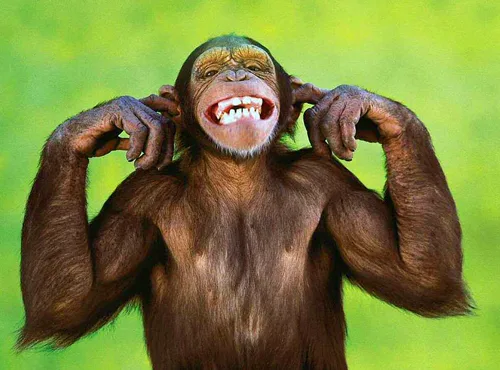
The assumption that the ability to revise one’s beliefs based on new evidence was an exclusively human trait has just collapsed. A revolutionary new study, conducted on primates at the Ngamba Island Sanctuary in Uganda, demonstrates that chimpanzees not only form logical expectations but are willing to change their minds when new facts emerge.
A humbling discovery for our species, which is often prone to ignoring evidence.
Sophisticated Reasoning: Chimps Outsmart Human Dogma
How often have we heard the famous saying (often misattributed to John Maynard Keynes): “When the information changes, I change my mind. What do you do?”
Yet, many humans seem incapable of abandoning their convictions, even in the face of overwhelming proof. The animal intelligence of our primate cousins, however, appears more flexible than we thought.
Dr. Emily Sandford of the University of California, Berkeley, and her team tested chimpanzees in an ingenious experiment: hiding food in one of two boxes and providing clues of varying “quality” to see if the primates not only chose the right box but, crucially, if they re-evaluated their choice based on subsequent information.
Study Objective: To verify whether chimpanzees could not only change their decision but also assess the weight of the new evidence.
How Does Chimp Cognition Work?
The researchers used computational models to analyze the chimpanzees’ choices. The results, published in the prestigious journal Science, were astonishing:
- Evidence Evaluation: The chimpanzees didn’t just react to change; they evaluated whether the new information was convincing enough to justify altering their initial belief.
- Clue Hierarchy: Being highly visual animals, the most compelling evidence was the direct sight of the food. Sounds and traces were considered intermediate or weaker clues, demonstrating a clear capacity for discernment.
- Rationality: In the experiments, chimpanzees chose the rational option two to three times more often than the irrational one, even in complex scenarios (such as when an initial clue was contradicted by later evidence).
Four-Year-Old Level Thinking: “The chimpanzees were able to revise their beliefs when more compelling evidence emerged. Such flexible reasoning is something we typically associate with four-year-old children,” commented Dr. Sandford.
Metacognition: No Longer Just Human
The study concludes with a powerful observation: “Our results provide solid evidence that chimpanzees possess authentic metacognitive capabilities”—that is, the ability to reflect on their own thought processes.
This research not only elevates our understanding of animal intelligence but reinforces Darwin’s ancient intuition: “The difference between humans and chimpanzees is not categorical, but rather a continuum,” as Dr. Sandford notes.
The research is now extending to young children to trace the evolutionary path of this reasoning ability more accurately. It seems great apes are confirming Darwin’s prediction, bridging the gap between human and animal cognition with their humble, yet powerful, capacity to change their minds.
The study was published in the journal Science.