Scientists have long known that Earth hides extraordinary secrets beneath its surface, but two colossal, mysterious structures buried deep below our feet may finally help explain why our planet became uniquely habitable. According to a new study published in Nature Geoscience, these ancient features could preserve the chemical fingerprints of early core–mantle interactions—processes that may have shaped Earth’s oceans, atmosphere and, ultimately, the rise of life.
For decades, researchers struggled to understand the true nature of these vast formations, whose size, temperature and composition differ so radically from the surrounding mantle that traditional geological models failed to explain them. Now, new work led by Yoshinori Miyazaki, a geodynamicist at Rutgers University, offers a compelling theory that reframes our understanding of Earth’s earliest history.
What Lies Beneath: Giant Structures at the Core–Mantle Boundary
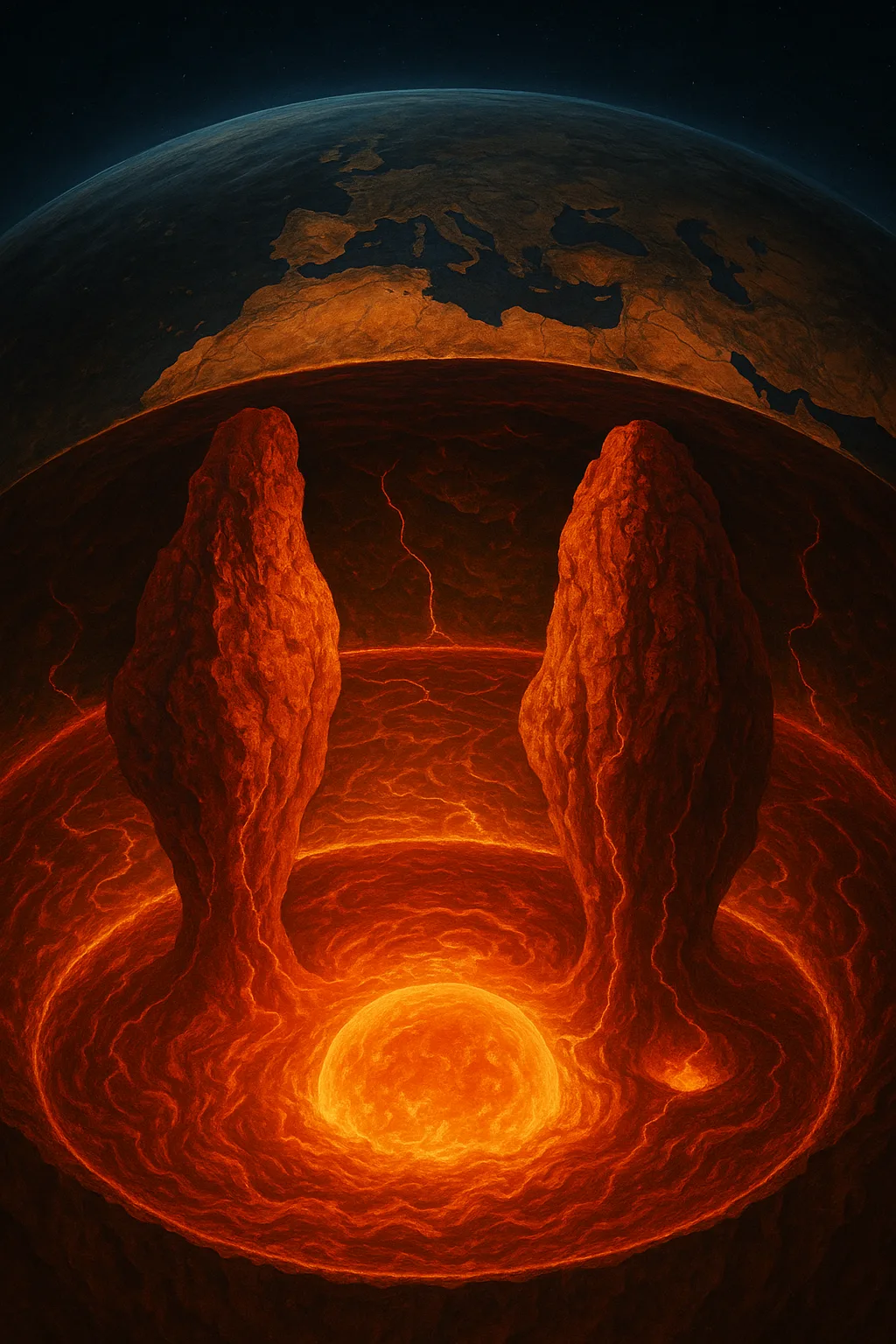
The two structures at the center of this scientific mystery are known as large low-shear-velocity provinces (LLSVPs) and ultra-low-velocity zones (ULVZs). They sit roughly 1,800 miles (2,900 kilometers) beneath Earth’s surface, resting atop the molten metal outer core.
- LLSVPs are massive, continent-sized piles of hot, dense rock—one beneath Africa and the other under the Pacific.
- ULVZs are thin, patchy layers that appear partially molten and cling to the core like glowing pools.
Both structures dramatically slow down seismic waves, indicating that they contain exotic materials unlike the surrounding mantle. Their size alone is astonishing: if brought to the surface, each LLSVP would dwarf entire continents.
“These are not random oddities,” Miyazaki said. “They are fingerprints of Earth’s earliest history. If we understand why they exist, we can understand how our planet formed—and why it became habitable.”
Earth’s Fiery Beginning: Clues From the Ancient Magma Ocean
Billions of years ago, newborn Earth was covered by a global ocean of molten rock. This early “magma ocean” slowly cooled and solidified, laying the foundation for all of Earth’s geological layers.
Many scientists expected this cooling to create clear chemical stratification—much like how oil and water separate. But seismic data shows a different picture: instead of distinct layers, the deep mantle contains irregular piles and patches such as LLSVPs and ULVZs.
“That contradiction was the starting point,” Miyazaki explained. “If we model Earth’s mantle beginning with a magma ocean, we don’t end up with anything like what we see today. Something was missing.”
A Surprising Culprit: Materials Leaking From Earth’s Core
The breakthrough came from considering a process most models overlook: slow chemical leakage from the core into the mantle over billions of years.
Using geodynamic simulations and mineral physics data, the researchers propose that elements such as silicon and magnesium gradually escaped from the core, mixing into the base of the mantle.
This core-derived material could have:
- prevented strong chemical layers from forming,
- altered the composition of the basal mantle, and
- produced the unusual seismic signatures of LLSVPs and ULVZs.
“What we proposed was that the material might be leaking out from the core,” Miyazaki said. “When you add the core component into the model, you can suddenly explain what we see.”
The study suggests that the LLSVPs may be the cooled remnants of a long-lost “basal magma ocean”—a hidden geological archive shaped by early core–mantle interactions.
Deep Earth Processes and the Origins of Life
The implications of this discovery reach far beyond mineral composition. The core and mantle are responsible for controlling how Earth cools, how volcanoes form, and even how the atmosphere evolves.
These internal processes may help explain:
- why Earth kept its water,
- how volcanic outgassing contributed to the early atmosphere,
- why Earth remained geologically active, while
- Venus became a runaway greenhouse furnace, and
- Mars lost its atmosphere and water, becoming cold and barren.
“How a planet cools and how its layers evolve could be a big part of the answer,” Miyazaki noted.
The study strengthens the idea that Earth’s deep interior—far below the surface—played a crucial role in making the planet habitable.
A New Framework for Earth’s Interior and Hotspot Volcanoes
Beyond explaining ancient history, the research provides insight into modern geological phenomena. The extreme heat and chemistry of LLSVPs and ULVZs may help drive mantle plumes, the fiery upwellings beneath volcanoes such as:
- Hawaii,
- Iceland,
- Galápagos, and
- other hotspot regions.
This means that traces of Earth’s earliest formation may still be influencing volcanic activity today—linking the deep mantle directly to the modern surface.
“This work shows how combining planetary science, geodynamics, and mineral physics can help solve Earth’s oldest mysteries,” said co-author Jie Deng of Princeton University.
Reconstructing Earth’s Earliest Chapters
Each new discovery adds another piece to the puzzle of Earth’s formation. What once seemed like isolated clues—unusual seismic signatures, unexpected mantle chemistry, hotspots—now appears to be part of one coherent story.
“Even with very few clues, we’re starting to build a story that makes sense,” Miyazaki said. “This study gives us a little more certainty about how Earth evolved, and why it’s so special.”