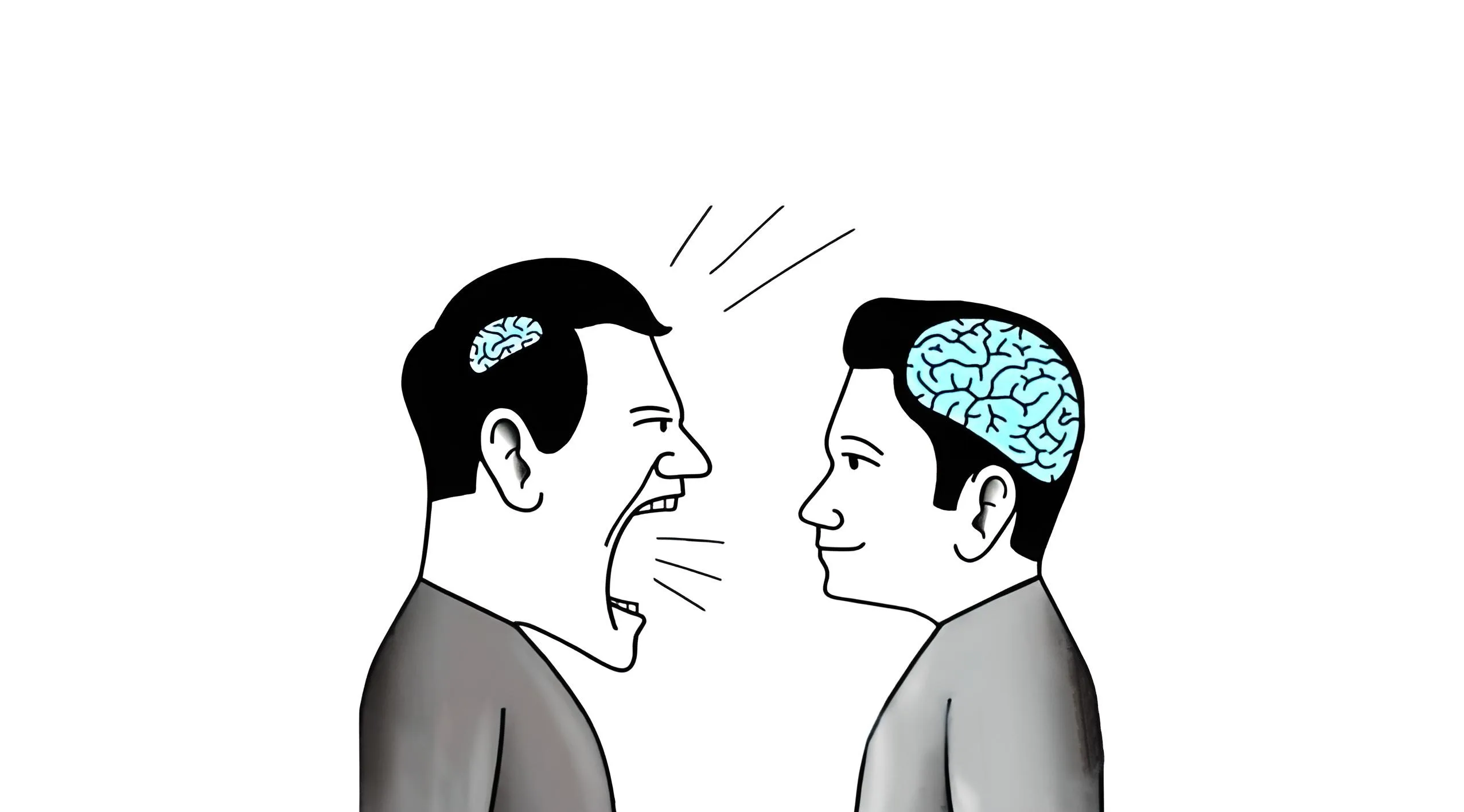
Self-perception is a slippery slope — and sometimes, it plays surprising tricks on us.
One of the most fascinating phenomena in modern psychology is the Dunning-Kruger effect, which explains why people with limited skills in a certain area tend to overestimate their competence, while true experts often underestimate their own abilities.
It’s like looking into a distorted mirror: the less you know, the greater you think you are; the more you know, the smaller you seem to yourself.
The origin of the Dunning-Kruger effect: an incredible true story
The Dunning-Kruger effect was first described in 1999 by psychologists David Dunning and Justin Kruger at Cornell University.
Their groundbreaking study, published in the Journal of Personality and Social Psychology, began with a story so absurd it sounds fictional:
A man tried to rob two banks after covering his face with lemon juice, believing that the cameras wouldn’t record him.
Why?
He had heard that lemon juice can be used as invisible ink on paper and assumed the same logic would make his face invisible. When he was arrested, he was shocked to see the footage.
This bizarre event made Dunning and Kruger wonder:
Could ignorance itself lead to overconfidence?
Their research confirmed it — and thus, the Dunning-Kruger effect was born.
The psychology behind the illusion of superiority
At its core, the Dunning-Kruger effect reveals a powerful paradox: the less competent someone is, the more confident they tend to be.
People who lack skill in a certain area also lack the metacognition — the ability to recognize their own lack of skill.
In short, they don’t know what they don’t know.
Imagine a new driver who has just learned how to start the car but already feels ready for Formula 1.
Their lack of knowledge prevents them from seeing their own mistakes, making them blindly self-assured.
On the other hand, true experts suffer from what psychologists call the “curse of knowledge.”
Because they deeply understand their field, they assume others have similar knowledge and think that what they know is obvious or trivial.
This leads to self-doubt and, sometimes, difficulty communicating with less experienced people.
How the Dunning-Kruger effect shapes our daily lives
The Dunning-Kruger effect is everywhere — in workplaces, classrooms, politics, and social media.
- At work: underperforming employees may be the loudest voices in the room, convinced they deserve a raise or promotion. Meanwhile, skilled workers often question their worth.
- In education: students who misunderstand concepts may believe they’ve mastered them, while high achievers constantly feel they “don’t know enough.”
- In politics and public debate: people with shallow knowledge on complex topics — economy, climate, health — often express their opinions with the strongest conviction, fueling misinformation.
- In everyday life: someone who reads a few articles on nutrition might feel like an expert, risking poor choices that harm their health.
In every case, the Dunning-Kruger effect acts as an invisible bias, shaping how we evaluate ourselves and others — often to our own detriment.
How to overcome the Dunning-Kruger effect
The first step toward overcoming the Dunning-Kruger effect is awareness.
No one is completely immune, but recognizing it can help reduce its impact.
Here are a few strategies that make a difference:
- Commit to lifelong learning. The more we learn, the more we realize how vast a field truly is. Real competence brings humility, not arrogance.
- Practice critical thinking. Ask yourself: “Why do I believe this? What evidence do I have? Could there be another explanation?”
- Use objective measures. Evaluate your performance with data, feedback, or clear benchmarks — not just gut feeling.
- Embrace intellectual humility. Saying “I don’t know yet, but I’m willing to learn” is not weakness — it’s a sign of genuine intelligence.
Conclusion: the wisdom of humility
The Dunning-Kruger effect is not a personal flaw — it’s a universal psychological tendency rooted in how our minds work.
We all experience it, especially when stepping into new or unfamiliar areas.
The danger lies not in making mistakes, but in refusing to see them.
True wisdom begins when we can look at our own limitations without fear or defensiveness.
The more we understand the complexity of the world, the more thoughtful, flexible, and open we become.
And that openness protects us from the trap of self-satisfaction.
Because in the end, the smartest people aren’t those who know everything — they’re the ones who know how much they still have to learn.